Loading...
Rights and Wellbeing at Work
A Getting Started Guide
This document is licensed under a Creative Commons Attribution-ShareAlike 4.0 International License

 . You are free to share (copy and redistribute the material in any medium or format) or adapt (remix, transform, and build upon) the material with appropriate attribution. You must give appropriate credit, provide a link to the license, and indicate if changes were made. You may do so in any reasonable manner, but not in any way that suggests that the authors or The Embedding Project endorse you or your use of our work product.
Stephanie Bertels and Mahroo Shahbaz. Workforce Planning and Employee Development: A Getting Started Guide. (Embedding Project, 2025).
DOI: 10.6084/m9.figshare.29360588
This guide is part of our series of Getting Started Guides that supports your company to develop an embedded sustainability strategy. Each guide tackles a specific sustainability sub-issue and explores what your company needs to do to support the resilience of the environmental and social systems around you.
In each guide, we address relevant trends, system thresholds, key concepts, key actors, and key resources. We also offer guidance on how to address the impacts of decisions and activities in your operations and value chains as well as developing credible goals and outlining key corporate actions and internal targets that can help to provide clarity on the work ahead.
We recommend you read the first guide in the series, Getting Started Guides: An Introduction, which explains our overall approach and the value of setting a clear strategy anchored in your company’s most material issues. It also explains how you can leverage process-based interim targets to clearly outline and track the specific actions that your company needs to take to achieve its high-level goals.
A complete list of focus areas and sub-issues can be found in our guide Scan: A Comprehensive List of Sustainability Issues for Companies.
This guidebook addresses Workforce Planning and Employee Development, which is part of the broader sustainability issue topic of Rights and Wellbeing at Work.
To address the broad topic of Rights and Wellbeing at Work, we have separated out sub-issues into separate guides, so that we can address them in depth. The table on the next page provides a brief overview of our guides related to Rights and Wellbeing at Work and the key topics each guide covers. For specific information and guidance related to any of the key topics, please refer to the appropriate guide.
| Guide | Key topics covered |
|---|---|
Human Dignity and Integrity (Tackling Modern Slavery): A Getting Started Guide | Freedom from torture, cruel, inhuman, or degrading treatment, or punishment; Freedom from violence or exploitation; Freedom from child labour, forced or compulsory labour, debt bondage, prison labour, or other forms of modern slavery; No human trafficking; No deceptive recruiting practices |
Safe and Healthy Working Conditions: A Getting Started Guide | Right to safe and healthy conditions of work; Right to refuse unsafe work; Occupational hygiene; Occupational health and safety; Appropriate and safe work from home; Natural lighting and airflow; Climate-related health and safety impacts |
Fair compensation; In-work poverty; Family living wage/income; Equal pay for equal work; Eliminating pay disparities; Predictable payment timing; Useable/regionally appropriate currencies; Fair compensation in piecework jobs | |
Businesses need to ensure that they have the right workers with the right skills in place to successfully deliver on their corporate (and sustainability) goals. They need to anticipate their future workforce needs and put in place a strong talent development strategy to address any skills gaps. This can be increasingly difficult to do in a rapidly shifting global labour context.
Several global shifts are transforming the world of work. There has been an increasing erosion of the ‘standard employment relationship’ previously characterised by stable long-term, full-time hours, with fair wages and benefits such as vacation pay. While for some, the rise of remote, part-time, and more flexible work arrangements has brought advantages, these trends have also negatively re-shaped the employee-employer relationship for many others and led to more precarious work.
Furthermore, trends such as broadening digital access, technology advancements such as increasing automation and the rise of artificial intelligence, the impacts of climate change, and changes in energy generation are expected to transform economic and company priorities over the short- to medium-term. These trends are greatly impacting workers, shifting the types of skills, knowledge, and competencies needed to keep up with an ever-changing world. The Future of Jobs Report 2025 by the World Economic Forum (WEF) indicates that “these trends are expected to have a divergent effect on jobs, driving both the fastest-growing and fastest-declining roles, and fuelling demand for technology-related skills,” and that, within the next five years, “workers can expect that two-fifths (39%) of their existing skill sets will be transformed or become outdated.”

Adapted from World Economic Forum
To close the skills gaps and ensure that they retain the talent within their workforce and support their skills growth, companies will need to engage in workforce planning and employee development. This can include effective feedback and performance management for workers, supporting employee career planning, providing capacity building and personal development opportunities aligned with employee and business needs, and creating upskilling and reskilling strategies to support employees as their workplaces shift.
To deliver on your organisation’s sustainability goals, building awareness, knowledge, and competencies for sustainability will also need to be a key area of focus. Your employees need to possess the knowledge, skills and experience to adequately respond to mounting environmental and social challenges and expectations. Yet, many companies are ill-prepared. LinkedIn’s Global Green Skills Report 2024 found that “[b]y 2030 [, …] one in five jobs will lack the green talent to fill it [, … and that] by 2050, this gap will balloon to one in two jobs.” Furthermore, companies often identify a lack of a trained workforce and ineffective strategies for upskilling sustainability competencies in their organisation as a barrier to advancing sustainability goals. As we shift towards a more sustainable economy, workers with sustainability competencies and skills will be crucial to designing, driving, and monitoring progress.
Investing in workforce planning and employee development is not just a crucial part of the employee experience and lifecycle; it also offers various benefits to businesses and their continuity. It supports employee engagement and job satisfaction and can help with talent recruitment and improve retention rates. Companies that help their employees build skills also have higher internal mobility rates, highlighting the advantages of adopting a talent management model that allows employees to explore new opportunities and skills.
Note: Sustainability issues are generally systemic issues, because they are deeply interconnected and rooted in complex environmental, social, and economic systems. In these guides, a system threshold is defined as the point at which the resilience of an environmental, social, or economic system becomes compromised. This occurs when the total impacts imposed on the system exceed its capacity to assimilate those impacts.
Employers need to proactively engage in workforce planning. Businesses should adopt a dignity-oriented approach to people management, and avoid shifting the burden of economic risk onto individual workers and their families by creating precarious work.
The knowledge and competencies needed for workers and companies to succeed are rapidly evolving as external drivers permanently change the world of work. Companies need to support employee development to ensure that their workforce is ready to tackle the sustainability transition, technological change, economic uncertainty, and other global shifts.
Workforce planning is the process of balancing labour supply and skills against current and projected workforce needs. It includes forecasting future workforce needs, analysing your current workforce’s supply and skills, identifying any gaps, and developing and implementing talent management interventions so that your organisation can fulfill its goals and strategic objectives while treating your workforce with respect.
Poor workforce planning can lead to unequal workload distribution, contributing to employee dissatisfaction and a sense of unfairness. Whereas proactive workforce planning that promotes fair workload distribution and invests in employee development can improve working conditions and increase employee satisfaction, retention, and productivity. That is why leading organisations are proactive in understanding their future workforce needs, identifying gaps, and planning to address projected shortages, surpluses, or skill mismatches.
In pursuing workforce flexibility, employers need to be attentive to the potential for negative impacts on workers. Employers should avoid shifting the burden of economic risk on to individual workers and their families by creating precarious work.
Precarious work generally refers to work that is poorly paid, insecure, and has little institutional or legal protection. Precarious work involves a combination of employment instability, low wages or compensation, de-standardised working time arrangements, eroded workers’ rights and protections, exposure to a range of work-based harm, limited training and progression opportunities, and imbalanced interpersonal power relations between workers and employers. According to the Work Rights Centre, this includes situations where “workers’ pay barely covers living costs, where employment contracts are missing or hyper-flexible, and where workers lack access to basic employment rights such as paid leave or breaks”. Supporting fair compensation in piecework, the gig economy, and other precarious work situations is addressed in Fair Compensation: A Getting Started Guide.
Companies should also understand how and when they are relying on informal workers in their operations and value chains. The Organisation for Economic Co-operation and Development (OECD) estimates that informal workers make up nearly 60% of the workforce globally, and 90% in low-income countries. As the C40 notes, these workers include “waste collectors, landscapers, agricultural workers, day labourers, rideshare and taxi drivers, cooks and other roles that often fall outside labour legislation, taxation, benefits and social protection.” According to the International Labour Organization (ILO), for most workers, informal employment is a “last-resort” option for earning a living.
During times of reorganisation or restructuring, it may be necessary to let go of workers. Leading companies are attentive to avoiding – and where necessary, managing – the need for workforce reductions and retrenchment, and work to minimise the impact of job losses on workers and their families. The International Finance Corporation (IFC) recommends proactive consultation with workers, exploring alternatives to job losses, establishing clear and non-discriminatory criteria, and developing a plan to mitigate impacts on affected workers and their families. In many jurisdictions, workers will be entitled to severance. Leading companies also often choose to fund career counselling, retraining, and/or other assistance for affected workers (either on their own or in partnership with government or other partners).
Leading organisations adopt a more sustainable and dignity-oriented approach to people management and aim to avoid creating precarious work arrangements. Their workforce planning strategies seek to maintain flexibility while upholding decent work.
It is also crucial to embed sustainability across the employee life cycle. Sustainable human resources management takes a long-term view, seeking to design jobs that benefit workers and encourage job stability. With sustainable HRM, employees are valued as assets, not just short-term resources.
According to our research, leading companies recruit talent that is aligned with their organisation’s sustainability goals. They equip recruiters with a strong understanding of their organisation’s sustainability commitments and performance along with role-relevant examples of how potential employees can contribute. During onboarding, they share more information about the company’s sustainability initiatives and how new employees are encouraged and supported to participate in them.
Leading companies also integrate sustainability into employee roles and job descriptions. They incorporate sustainability into their performance expectations and performance management. Relevant sustainability goals and targets link individual and team performance to the organisation’s sustainability objectives and are incorporated into performance evaluations. Leading companies also identify and foster sustainability competencies. They consider sustainability competencies as part of promotion decisions and include evidence of acting in alignment with the organisation’s sustainability goals as part of the narrative that justifies promotion. They invest in employee learning and development and are proactive in succession planning and leadership development.
Our research reveals that leading companies proactively develop employees’ skills and competencies through mentorship, targeted training and development programs, and further relevant educational and development opportunities. Investment in employee skill building for the lowest paid workers in your operations and value chain is particularly important because workers are more vulnerable to precarious work when they have limited opportunities to obtain and maintain relevant skills.
Companies should consider both upskilling and reskilling of employees to offer new opportunities and support their growth. Upskilling refers to workers learning new skills or capabilities to enhance their existing roles, whereas reskilling involves learning new skills to transition to an alternative role.
Leading companies also ensure that employees have the knowledge and skills to contribute to their sustainability efforts and embrace these organisational values. Building sustainability competencies and sustainability-related knowledge and skills becomes crucial to deliver on your organisation’s commitments, ensure compliance, and foster innovation.
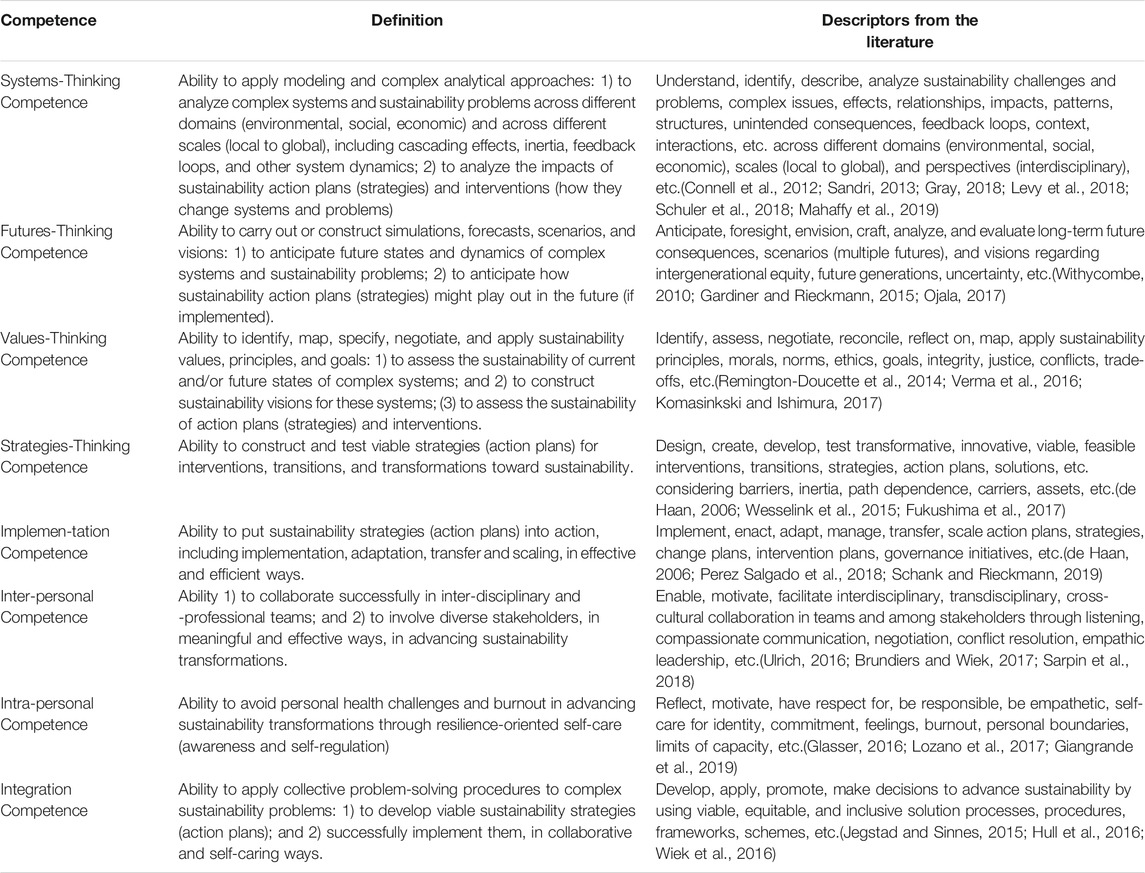
As outlined in the table below, key sustainability competencies include issue-specific knowledge that is relevant to the organisation’s key impacts – from addressing climate change to protecting and restoring nature to upholding human rights and supporting community resilience. They also include more broadly applicable knowledge that is crucial to understanding the interconnectedness and holistic nature of environmental, social, and business impacts such as systems thinking, anticipatory thinking, values-based thinking, strategic competence, and interpersonal competence.
| Topic | Definition |
|---|---|
Literacy in key sustainability issues | Awareness and understanding of emerging environmental and social issues and trends, the health and resilience of key environmental and social systems, the impacts stemming from your own operations and those of your value chain partners, and the risks and opportunities they create for your business. |
Systems / holistic thinking | The ability to recognise and understand relationships; analyse complex systems across different domains (society, environment, economy, etc.) and across different scales (local to global); to consider cascading effects, inertia, feedback loops; and to deal with uncertainty. |
Anticipatory / futures thinking | The ability to understand and evaluate multiple scenarios for the future – possible, probable and desirable; to collectively analyse, evaluate, and craft rich “pictures” of the future; to apply the precautionary principle; to assess the consequences of actions; and to anticipate and plan for risks and changes. |
Normative / values-based thinking |
Adapted from: Wiek, A., Withycombe, L. & Redman, C.L. Key competencies in sustainability: a reference framework for academic program development. Sustainability Science 6, 203–218 (2011). https://doi.org/10.1007/s11625-011-0132-6
The International Labour Organization (ILO) aims to promote social justice and internationally recognised human and labour rights. The ILO’s Decent Work Agenda provides a framework that embeds decent work as a core component of a fair and inclusive society and aims to promote decent work for all. It has four strategic objectives: employment, social protection, social dialogue, and rights at work.
The Reskilling Revolution by the World Economic Forum aims to inspire large-scale global systems change across the employment and education agendas by demonstrating, in a tangible way, how progress can be achieved on highly complex and intractable issues by reframing and piloting new models and templates for action; coordinating collective action at scale; and strategically raising the bar on credible business leadership commitment to these issues.
Note: The most relevant organisations related to employee development will often depend on your organisation’s location, industry context, and needs. You will likely need to engage with local actors to understand the relevant key players to support your strategy.
Committing to take action on Workforce Planning and Employee Development can include addressing many of the key topics listed above. The mid- and long-term commitments that your organisation elects to make should be based on your identified priorities, areas of greatest impact, and your capacity to undertake the work required. It is important to note that this section does not provide all possible mid- and long-term goals related to this issue, but rather a sample of the goals that were most frequently adopted by companies in our research.
Common mid- and long-term goals and/or commitments on Workforce Planning and Employee Development include variations of the following:
Are you setting new goals or interested in benchmarking your goals against leading practice? Explore our Sustainability Goals Database for more mid- and long-term goals on Workforce Planning and Employee Development.
Note: The following proposed timelines are only for guidance and are based on the pace outlined by other companies. The timeframe for actions and work for each step needs to be embedded in your organisational context, which may require different time allocations.
Understand your current organisational structure and inventory the knowledge and skills that are required for different roles. Then, identify trends in future skills and technologies that may reshape your workforce – for example, a predicted rise in automation, AI, or other digital skills that will redefine the skills your workforce will need. Compare these to determine gaps in skills or knowledge that will need to be filled, as well as timeframes for these changes. Conduct reviews for knowledge transfer systems to understand how you are currently addressing these gaps and identify room for improvement.
Assess employees’ development and training needs through engagement, feedback mechanisms, and performance evaluations. Much of this work will rely on having strong company-worker relationships and effective feedback mechanisms for employees, which are addressed in more detail in Company-Worker Relations: A Getting Started Guide.
Based on your understanding of employee experiences, consider where your current employee development programs are succeeding and where they may be falling short. Analyse the trends and gaps in future-fit skills across the organisation to identify areas of improvement in line with your strategic goals and commitments. This can also include conducting a job analysis to identify the skills and knowledge required for specialised positions, and which roles in your organisation may be the best fit for upskilling or reskilling.
Leveraging data from a decentralised skills-based learning navigator within their existing platform, Siemens – a German multinational technology company – aims to get insights on in-demand roles, skills, and employee development needs within its workforce. The company identifies skills gaps by encouraging employees to develop skills profiles to self-assess skills for future roles, and then leveraging the skills evaluation to improve workforce planning, development offerings, and other learning interventions.
Conduct an equity audit in respect to professional and career development in your organisation. Aim to understand discrepancies in training and mentoring programs – are there certain groups or identities that are lacking in opportunities or consistently under-invested in? Do your current talent development processes replicate inequities that are perpetuated in the broader social context?
Many companies investing in skills programs often disproportionately invest in higher-skilled employees through future leadership pipelines. This can exacerbate divides between skilled employees and those that may need upskilling or reskilling. Undertake an analysis to identify whether certain groups, such as senior leadership, receive disproportionate investment and whether there are other groups of employees that are underserved.
Build upon the workforce planning process started in year one to develop and clarify a high-level strategy for talent management. Clearly define high-level short and long-term commitments and goals for your workforce, and allocate responsibilities, resources, and supports for developing action plans to meet them (see the following section for guidance on talent development action plans). Also begin the work to build an internal narrative that understands the value of worker skills and prioritises talent investments on the same level as financial investments. Share the plan with workers and ensure there are opportunities for them to provide feedback to build consensus throughout the organisation. Collaborate with governments, community groups, and other institutions on creating workforce development programs to ensure a robust talent pipeline. Keep the strategy flexible – plan for multiple scenarios and build processes to review and update this strategy as new technologies emerge or new skills and capabilities become required for your industry.
Leverage your understanding of current employee and future skills needs identified under your workforce planning process to develop an action plan for investing in training and development over a set timeframe. Invest in skills development that supports varied career paths across the business to support employees career development in key competency and skills areas. Offer a range of programs and training formats to accommodate different learning styles and preferences. Providing access to resources that help employees build their skills at their own pace and mentorship or coaching programs that provide employees with personalised feedback and guidance can be key levers to support their career and skill development. Also consider upskilling or reskilling programs that offer opportunities to get trained while at work to further reduce barriers for engagement.
Offering funding for upskilling and reskilling opportunities can also incentivise learning and help individuals develop new skills without stress of monetary impacts. Companies may also create programs that offer tuition-free learning opportunities for employees to acquire new skills or degrees to advance their careers depending on organisational capacity. This can be particularly crucial in addressing barriers for historically marginalised groups that face inequality in access to educational opportunities. Investments in employee skill building for the lowest paid workers in your operations is particularly important because these workers are often the most vulnerable to precarious work when they have limited opportunities to obtain and maintain relevant skills.
Beyond development opportunities, also look to improve your performance and feedback management processes to better support employees. Leverage your understanding of employee needs to determine where there is room for improvement in current processes. Encourage employees to set up individual development plans to support career planning, and develop expectations for managers and employees to check-in and align on performance and development goals as needed to ensure that their plans are on track or to identify where extra support may be needed.
Recognising that significant changes were needed to ensure employees were able to effectively transition to skills needed for the future, Natixis – the Global Financial Services division of Groupe BPCE, the second largest banking group in France – revamped its internal mobility policies and practices to embed a skills first approach. The company’s ‘Jobs in Motion’ places internal mobility, career planning and progression, upskilling, and reskilling at the core of their talent development strategy. They have developed various tools and solutions, such as a professional development tool that offers targeted training recommendations (among a range of other functions) and have shifted their recruiting focus from traditional metrics to competencies and skills.
Understanding that the skills needed for the green energy transition were rapidly evolving and resulting in age discrimination as new technological knowledge and skills took priority, Enel created the Re-Generation training program in partnership with Università Telematica Internazionale Uninettuno. It is meant for workers over the age of 45 to update their skills and earn credits towards a university degree. It offers an opportunity to participate in short 8 - 10 week university courses on key topics on a flexible schedule to balance work and home commitments with their studies.
Build your understanding of what kinds of knowledge and competencies are needed for your organisation to achieve your sustainability ambitions. Consider how this differs across your organisation – for example, does your leadership team need a more thorough understanding of the complexities of climate change and its interlinked issues and risks to your organisation, or would certain action teams benefit from greater opportunities for competency development? Based on your understanding of where sustainability competencies are needed in your organisation, prioritise knowledge areas and teams for sustainability-focused development opportunities.
Understand where any forms of precarious work – such as temporary, casual, or informal work – are used within your organisation and why. Where possible, set commitments to transition employees to contracts with guaranteed hours and benefits to ensure workers are able to accurately anticipate financial flows to meet their needs. Also consider setting commitments for temporary contracts to only make up a certain percentage of your workforce to limit the use of precarious work to reduce labour costs and ensure current employees can retain job security.
Over the previous decade, the use of “zero-hour contracts” or casual contracts where employers are not required to provide workers a minimum number of working hours have faced significant backlash in the U.K. for creating insecure and exploitative working conditions. In light of concerns raised by workers’ organisations and regulatory shifts by the government, various companies – such as JD Wetherspoon PLC (a pub chain), Whitbread PLC (a multinational hotel and restaurant company), and McDonalds (a multinational fast food chain) -committed to transitioning employees to fixed contracts that avoid precarious work.
When developing sustainability competencies, you may want to begin with senior leadership, then build out programs for management, team leaders, and the broader workforce based on your understanding from the previous step. Begin programs at the start of the employee lifecycle. Implement onboarding processes that orient new employees to your sustainability ambitions and equip them with relevant resources to encourage learning. Create plans to invest in sustainability competency development for critical or decision-making roles to ensure sustainability can be embedded across the business. Consider whether organisation-specific training for sustainability can also support the development of a shared organisational narrative about sustainability.
In line with your workforce planning process, develop (or update) your retrenchment processes to better consider workers’ rights and concerns. Ensure you begin the process by exploring alternatives to layoffs or job cuts – can similar savings be achieved through current employees working less hours or upskilling employees into new roles? Your talent management strategy and talent development action plan should have pieces in place that can work to support this process. Establish clear policies and procedures for decision-making if retrenchment is unavoidable, ensure workers have access to appeal or grievance mechanisms, conduct proactive consultation with workers and workers’ organisations, establish clear and non-discriminatory criteria, and develop a plan to mitigate impacts on affected workers and their families. Also explore funding career counselling, retraining, and/or other assistance for affected workers (either on your own or in partnership with government or other partners).
Identify where and how precarious or informal work may intersect within your value chain. Collaborate with suppliers to share learnings about the importance of supporting just transitions for informal sectors. Where possible, require suppliers to hold direct employment contracts and agreements with all contract workers to protect vulnerable workers. Co-develop programs or provide support where feasible to help suppliers uphold these commitments.
Gap Inc. included provisions for short-term contracts within their Code of Vendor Conduct (COVC) that applies to all facilities that produce goods for the company to begin addressing the use of precarious work and short-term contracts in their value chain. The CVOC notes that “the facility shall ensure that where training wages are legally allowed, they are for a limited time frame and the facility shall not modify or terminate worker contracts (including the signing of a series of short-term contracts in immediate succession), work schedules, or location for the sole purpose of avoiding wage requirements.”
Workforce planning factsheet by the Chartered Institute of Personnel and Development (CIPD) explores the benefits of workforce planning and outlines the different stages in the workforce planning process.
Strategic Workforce Planning 101: Framework and Process by the Academy to Innovate HR (AIHR) provides a quick overview of strategic workforce planning. It offers a four-step framework, explains additional planning models and tools that may further support the work, and breaks down the components of the strategic workforce planning process.
Good Practice Note: Managing Retrenchment by the International Finance Corporation (IFC) covers good practice guidance for companies developing a retrenchment plan. It helps companies think through key issues in planning and managing retrenchment.
Ensuring responsible factory retrenchment, exit, and closure: Guidance for companies by the Fair Labor Association offers practical guidance on responsible retrenchment within manufacturing facilities, with the aim to minimise negative impacts on workers. While embedded within the Fair Labor Association’s Principles of Fair Labor and directed towards member companies, the guidance provided can support external companies to understand key expectations and responsibilities when dealing with retrenchment situations.
Breaking Vicious Circles of Informal Employment and Low Paying Work by the OECD explores links been informal employment and low wages, highlighting key disparities and concerns that leave workers increasingly vulnerable. While focused on policy solutions, it can offer an important overview of the issue to set the stage for understanding the implications of informal and precarious work.
The Informal Economy and Decent Work by the ILO offers various resources directed at addressing decent work in the informal economy. This resource page offers links to explore the various dimensions of informal work, including regulatory approaches, insights on specific sectors associated with informal work, and the role of employers and other workplace organisations.
The Upskilling for Shared Prosperity report by the World Economic Forum and PwC is a call to action for wide-scale upskilling. It provides a quantitative analysis of the impact upskilling can have on economic growth. The research is complemented with a qualitative analysis that looks at the need for new economic thinking underpinned by the development of good jobs – work that is safe, paid fairly, reasonably secure and motivating, and that emphasises the uniquely human skills and traits of workers, thus delivering higher levels of productivity.
Empowering the Workforce of Tomorrow: The Role of Business in Tackling the Skills Mismatch Among Youth by the World Economic Forum and UNICEF highlights the importance of addressing the skills mismatch among youth, with a view to help businesses better understand the challenge, its root causes, and the impacts it has on youth and business.
Skill Strategies for a Sustainable World of Work: A Guide for Chief Human Resources Officers by WBCSD and GAN Global aims to inform and inspire CHROs and HR decision makers that are setting out on the skills development journey. It presents a wide range of effective and appropriate forward-looking skills strategies and pipelines, leveraging interviews with senior professionals and solutions from organisations around the world.
Putting Skills First: Opportunities for Building Efficient and Equitable Labour Markets by the World Economic Forum offers insights on the importance of a skills-first approach, including five opportunities for intervention, and provides case studies for best practice.
This introductory chapter, Components of a Successful Learning and Development Strategy, from Elevating Learning and Development was written by McKinsey & Company. This chapter provides an overview of the value of active learning and development (L&D) in large organisations, and includes nine dimensions that contribute to a strong L&D function.
This section titled Practices for Cultivating Capable Champions within Chapter 5 of Focusing on Organisational Change provides you with seven practices to cultivate capable change agents within your organisation.
This table by Redman, A. & Wiek, A. (2021) provides a quick overview of a framework of key competencies needed to push for sustainability across various disciplines. The associated article, Competencies for Advancing Transformations Towards Sustainability, offers insights in more depth.
UNESCO cross-cutting and specialized SDG competencies highlights eight competencies that are key in tackling the climate crisis and pursuing sustainable development.
Explore more curated resources on Workforce Planning and Employee Development here.
Respectfully engaging with workers; Freedom of association; Right to collective bargaining; Avoiding protracted negotiations; Psychological safety; Effective social dialogue; Regular, timely, and transparent worker communications; Worker surveys and other input and feedback tools; Works councils; Accessible and transparent worker grievance mechanisms; Whistleblower channels |
Respectful, Equitable, and Inclusive Workplace: A Getting Started Guide | Workplace culture; Freedom from bullying, harassment, humiliation, and intimidation; Diversity, equity, and inclusion (DEI/EDI); or inclusion, diversity, equity, and accessibility (IDEA); or justice, equity, diversity, and inclusion (JEDI); or diversity, equity, inclusion, and belonging (DEIB), and other acronyms; Freedom from discrimination; Freedom of opinion and expression; Freedom of thought, conscience, and religion; Right to privacy; Respect for group rights (such as the rights of Indigenous Peoples); Cultural leave; Respect for protections for persons with disabilities, children, women and girls, persons belonging to national or ethnic, religious, and linguistic minorities, migrant workers, LGBTQIA2S+, older workers, and other groups; Workforce representative of broader society |
|---|
Workforce Planning and Emloyee Development: A Getting Started Guide (you are here) | Workforce planning; Avoiding precarious employment; Responsible retrenchment; Employee lifecycle aligned with sustainability; Feedback and performance management; Career planning; Opportunities for capacity building and personal development; Upskilling and reskilling; Building sustainability-related competencies |
|---|
Good health and wellbeing; Supporting work-life balance; Right to reasonable working hour limitations; Predictable work hours; Right to paid time off; Compassionate leave; Maternity and parental benefits; Elder or child care leave; Access to child care; Health promotion; Access to leisure and exercise; Accessible design; Healthy and culturally appropriate nutrition; Health and injury insurance and other health benefits; Reintegration support; Retirement benefits to support long term financial wellbeing |
The ability to understand and reflect on the norms and values that underlie one’s actions; understand and consider multiple worldviews; assess the (un-) sustainability of current and/or future states of social-ecological systems; and to negotiate sustainability values, principles, goals, and targets, in a context of conflicts of interests and trade-offs. |
Strategic competence | The ability to collectively design and implement interventions, transitions, and transformative governance strategies toward sustainability. This includes knowledge about the viability, feasibility, effectiveness, and efficiency of systemic interventions as well as potential unintended consequences. |
|---|
Empathy / interpersonal competence | The ability to learn from others; to understand and respect the needs, perspectives and actions of others; to understand, relate to, and be sensitive to others; and to facilitate collaborative and participatory problem solving. |
|---|