Loading...
Includes workforce planning; avoiding precarious employment; responsible entrenchment; employee lifecycle aligned with sustainability; feedback and performance management; career planning; opportunities for capacity building and personal development; and building sustainability-related competencies.

Share this Subissue on:LinkedIn

Businesses need to ensure that they have the right workers with the right skills in place to successfully deliver on their corporate and sustainability goals. They need to anticipate their future workforce needs and put in place a strong talent development strategy to address any skills gaps in a shifting labour market. Anchored in research, our Workforce Planning and Employee Development: A Getting Started Guide aims to support your company as it begins or revisits a talent management and development strategy. It helps build a foundational understanding of the issue and provides clarity on the work ahead.

This comprehensive insight report from the World Economic Forum can help you to understand how key macrotrends are expected to impact jobs and skills in the near future, as well as the workforce transformation strategies that employers plan to implement in response. Bringing together the perspective of over 1,000 leading global employers, the report examines the global labour market landscape in 2025; drivers of labour-market transformation, including technological change, geoeconomic fragmentation, economic uncertainty, demographic shifts, and the green transition; the jobs outlook, including total job growth and loss and the expected impact of macrotrends on employment; the skills outlook, including expected disruptions to skills, drivers of skill disruption, and reskilling and upskilling strategies; workforce strategies; and region, economy, and industry insights.

This factsheet from the Chartered Institute of Personnel and Development (CIPD) can help you to better understand the benefits of workforce planning. It explains workforce planning as a concept, outlines the different stages in the workforce planning process, and identifies key actions for implementing effective workforce planning. Beyond workforce planning teams, this is a good introductory resource for operations professionals and managers.

This guidance from the Academy to Innovate HR (AIHR) provides a quick overview of strategic workforce planning. It offers a four-step framework, explains additional planning models and tools that may further support the work, and breaks down the components of the strategic workforce planning process.

This white paper from the World Economic Forum can help you to better understand the potential futures arising from the interaction and intersection of AI advancement and talent development. Consolidating the views and insights from chief strategy officers and other experts around cross-cutting risks and opportunities, the paper provides four potential scenarios: Supercharged Progress, The Age of Displacement, Co-Pilot Economy, and Stalled Progress. This resource will be especially beneficial to sustainability practitioners, risk and strategy professionals, and senior leaders.

This good practice note from the International Finance Corporation can help you to develop a retrenchment plan to better plan for and manage significant job losses. It makes the case for getting retrenchment right; highlights key steps in planning and managing retrenchment; explains the importance of consultation, both on the development and implementation of retrenchment plans; and more. This resource will be especially beneficial to managers, senior leaders, and HR professionals.

This guidance from the Fair Labor Association offers practical guidance on responsible retrenchment within manufacturing facilities, with the aim of minimising negative impacts on workers. While embedded within the Fair Labor Association’s Principles of Fair Labor and directed towards member companies, the guidance provided can support external companies to understand key expectations and responsibilities when dealing with retrenchment situations.

In times of crisis, workers - especially those in the textile, garment, shoes, and leather (TGSL) industry - are laid off in large numbers. These workers often lose both their jobs and the severance to which they are entitled, threatening an immediate descent into poverty in operating contexts where state-backed social security is lacking. This guide from the Clean Clothes Campaign can help you to better understand the Pay Your Workers - Respect Labour Rights (PYW-RLR) Agreement: a sector-wide, cost-advantageous mechanism that enables workers to receive their severance payments after a factory closure or mass dismissal. The PYW-RLR Agreement offers a bridging solution that enables brands to implement a robust and responsible exit policy that can handle crises. The guide highlights the details of such an agreement, which features a global guarantee fund and a mechanism to identify, investigate, and remedy non-compliance and worker grievances in cases of failure of payment, anti-union retaliation or harassment, gender-based violence and harassment, or occupational health and safety violations. The guide also explains the benefits to businesses in supporting a PYW-RLR Agreement and features a comprehensive FAQ section.
Although written with the textiles industry in mind, this guidance contains concepts that are worth exploring and putting into practice in other industries and sectors. Specifically, this guidance will be relevant to companies with supply chains that face growing impacts of climate, ecological, and/or geopolitical emergencies, and where social safety nets are insufficient.

This short resource from ACT can help you to implement an effective process for responsible factory exits. The strategy applies to all exits from factories, whether the production unit has a direct relationship with your brand, is a sub-contractor, or is contracted by an agent. It includes a checklist for collecting information before exiting, including internal communication and initial risk assessment measures; a checklist for exiting, including supplier communication and ongoing risk assessment measures; and a checklist for immediately after exiting, including measures for assessing adverse impact on workers. This resource will benefit sustainability professionals, operations managers, and senior leaders.

This guide from the OECD can help you to understand the links been informal employment and low wages. It highlights key disparities and concerns that leave workers increasingly vulnerable, such as the scarcity of opportunities to transition between formal and informal employment and the scarcity of opportunities to upgrade their skills and transition to formal jobs. While focused on policy solutions, this guide offers an important overview of the issue and helps set the stage for understanding the implications of informal and precarious work.

This module offers an overview of the different dimensions of precarious work. It explores the dominant forms of precarious employment; explains how forms of employment and the extent to which they are precarious differ between nations; and examines how regulatory contexts and frameworks shape precarious forms of employment and their variation.
Although this resource is dated, the first three sections covering key concepts and indicators provide a good foundation for understanding precarious work.

This report from the World Economic Forum and PwC is a call to action for wide-scale upskilling. It provides a quantitative analysis of the impact upskilling can have on economic growth. The research is complemented by a qualitative analysis that looks at the need for new economic thinking underpinned by the development of good jobs – work that is safe, paid fairly, reasonably secure and motivating, and which emphasises the uniquely human skills and traits of workers to deliver higher levels of productivity.

This report from the World Economic Forum and UNICEF highlights the importance of addressing the skills mismatch among youth, with a view to help businesses better understand the challenge, its root causes, and the impacts it has on youth and business.

This guide from WBCSD was created to inform and inspire CHROs and HR decision makers that are setting out on the skills development journey. It presents a wide range of effective and appropriate forward-looking skills strategies and pipelines, leveraging interviews with senior professionals and solutions from organisations around the world.

This insight report from the World Economic Forum can help you to identify the enablers and actions for implementing a "skills-first approach," which focuses on whether someone has the right skills and competencies for a particular role, rather than how the skills have been acquired. It highlights five opportunities for intervention, and provides case studies for best practice.

This introductory chapter from Elevating Learning and Development was written by McKinsey & Company. This chapter provides an overview of the value of active learning and development (L&D) in large organisations, and includes nine dimensions that contribute to a strong L&D function. This chapter would be useful to L&D and HR teams focussed on reskilling and upskilling.

This section from "Focusing on Organisational Change" features seven practices that can help you to cultivate capable change agents within your organisation.

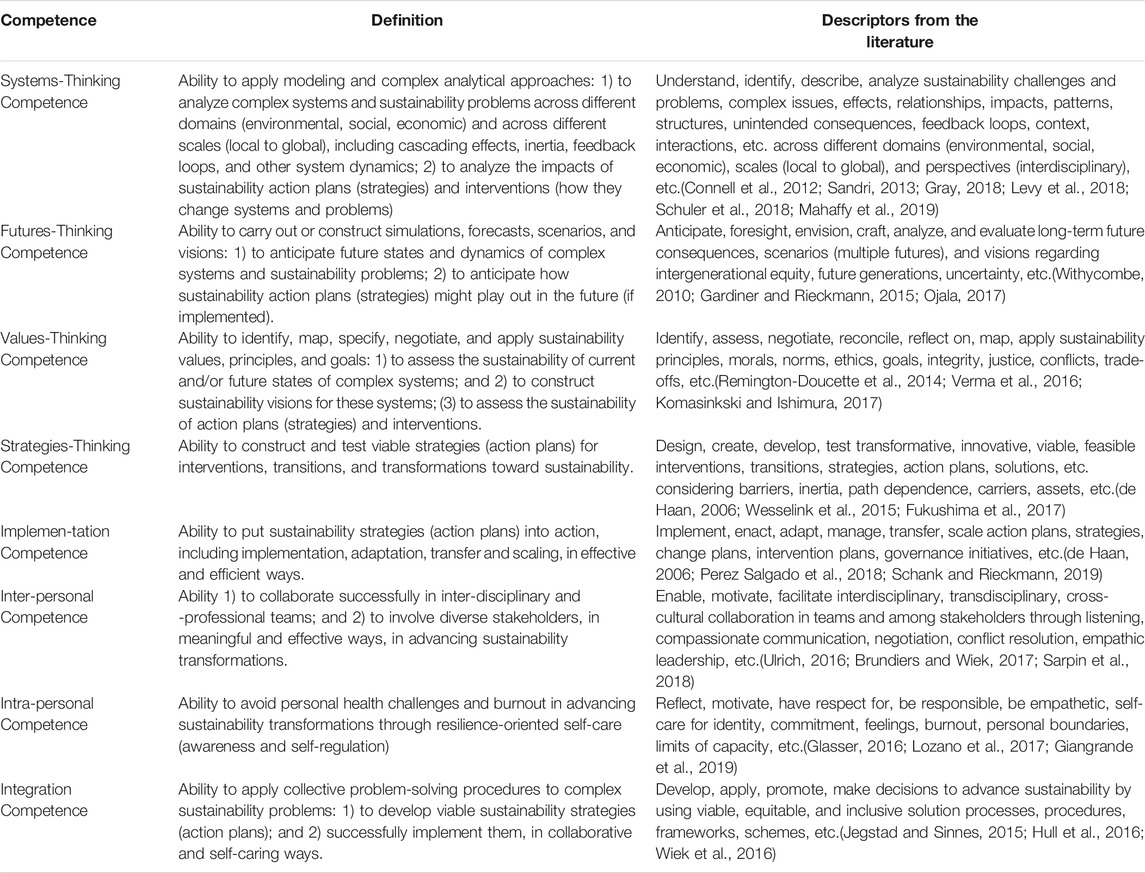
This table by Redman, A. & Wiek, A. (2021) provides a quick overview of a framework of key competencies needed to push for sustainability across various disciplines. The associated article, "Competencies for Advancing Transformations Towards Sustainability," offers insights in more depth.

These specialised and interrelated SDG competencies - compiled by the United Nations Educational, Scientific and Cultural Organization (UNESCO) in their publication “Education for Sustainable Development Goals: learning objectives” - are key to tackling the climate crisis and pursuing sustainable development.

This report from the World Economic Forum (WEF) and PwC can help you to better understand the impact of AI on entry-level work. Informed by insights from global stakeholders and workforce leaders across industries, it identifies priorities for safeguarding and reinventing early-career pathways. It also introduces a framework centered on four dimensions (job access, job design, talent pipelines and education system alignment) that can help organisations, educators, workers, and policy-makers to identify where strain is emerging and where deliberate action is needed.