How to Strengthen the Quality of Your Non-financial (ESG) Data
Share this post on:LinkedIn

Image by D.Schweitzer on Shutterstock
Evolving sustainability disclosure expectations are placing increasing pressure on companies to strengthen the quality of their non-financial (Environmental, Social, and Governance - ESG) data and bring their data processes more in line with those of their financial data. In this blog, we explore the growing need to strengthen non-financial data and the steps your company can take to improve ESG data quality and governance.
Why focus on improving non-financial (ESG) data quality?
Non-financial disclosures, often referred to as ESG reporting, go beyond core financial metrics to convey a company’s performance on environmental, social, and governance factors. Non-financial data includes both quantitative and qualitative data such as carbon emissions, workplace safety performance, water quality, waste, human rights due diligence, and more.
Credible ESG data helps organisations to understand and communicate their sustainability impacts and performance, supports better decision-making and enhanced risk management, and helps companies to better prioritise the allocation of scarce resources.
Stricter regulatory requirements, more stringent voluntary standards, investor demands for transparency, procurement requirements from customers, and the increasing role that non-financial information plays in assessing business risks and business value are all creating mounting pressure on companies to improve the quality of their non-financial data.
Key actions to improve the quality of your non-financial data
Rising disclosure expectations call for stronger processes and many companies will need to make further investments to improve how they collect, manage, use, and disclose non-financial data.
Your company needs to understand what data is most critical to the business – both in terms of informing decision-making and for disclosure. You also need to ensure that you have clear ownership and governance of data, have robust data-related processes, store data with the right management tools and supports, and have established procedures to test, verify, and improve data quality.
Below we outline some of the key actions that your company can take:
1) Focus on the right data - align your non-financial data with your most material impacts and relevant disclosure obligations
For many companies, their non-financial data strategy has been primarily driven by the needs of their annual sustainability report. For too long, companies were focused on providing the information prescribed by various regulatory and voluntary reporting standards.
As a result, many companies have been collecting data that they are not always actively using to inform decision-making, and those tasked with capturing the data are not receiving feedback on how to improve performance.
Start by asking: What is the information that is most critical to the business that needs to inform our decision-making and/or underpin our disclosures?
A credible understanding of your organisation’s impact materiality should guide your data strategy. The non-financial data you collect and manage should align with the key issues you have determined to be – or which may become – particularly relevant to your business (including the most material impacts of your operations and your value chain and the risks and opportunities these issues present to the business).
Companies are also increasingly expected to collect, use, and disclose non-financial information in alignment with key standards and frameworks. Therefore, another important reference point for determining the scope of your non-financial data strategy still needs to be your alignment with relevant disclosure standards and frameworks. For many organisations, seeking alignment with the International Sustainability Standards Board (ISSB) standards IFRS S1 and S2, the Global Reporting Initiative (GRI), and/or the European Sustainability Reporting Standards (ESRS) will provide a strong foundation for structured, comparable, auditable data. Many of these standards and frameworks already provide nuanced information on the types of data that should be collected, as well as collection methods.
Companies should also be tracking the relevance of emerging standards. For instance, ISSB has signaled that its next major standard, IFRS S3 (Biodiversity, Ecosystems and Ecosystem Services), will be anchored in the recommendations of the Taskforce on Nature-related Financial Disclosure (TNFD). The TNFD’s LEAP guidance already provides practical “how to” support and identifies the types of data that would meet TNFD disclosure requirements, with explanations of key criteria, recommended metrics, and reference datasets. TNFD has also produced even more nuanced metrics guidance and sector guidance.
Meanwhile, the Taskforce on Inequality and Social-related Financial Disclosures’ (TISFD) has started to focus on social issues and its Proposed Technical Scope features detailed recommendations on decision-useful indicators, metrics, and data.
2) Establish a robust data governance framework
Actionable, high-quality data depends on strong, thoughtful, transparent data governance.
Data governance can be defined as the exercise of authority, control, and shared decision-making (such as planning, monitoring, and enforcement) over the management of data assets. More simply, it can be understood as the “rulebook” that sets out the policies, procedures, and roles that develop, oversee, and coordinate how data is managed across an organisation – including how data is collected, organised, stored, accessed, used, transformed, shared, protected, monitored, and more.
There are many frameworks and models for effective data governance, but most share a similar purpose. They provide the strategic oversight and policy framework that ensures an organisation’s data is reliable, consistent, and compliant with regulations. They can help you to centralise your data, coordinate responsibilities, and ensure consistent integration and data governance across non-financial data domains.
For instance, it is important to assign clear domain owners for priority data sets as well as to define and empower stewardship roles. In practice, this means that key data needs an executive data owner, a data steward in charge of data quality, and appropriate data managers/data analysts gathering and analysing the data.
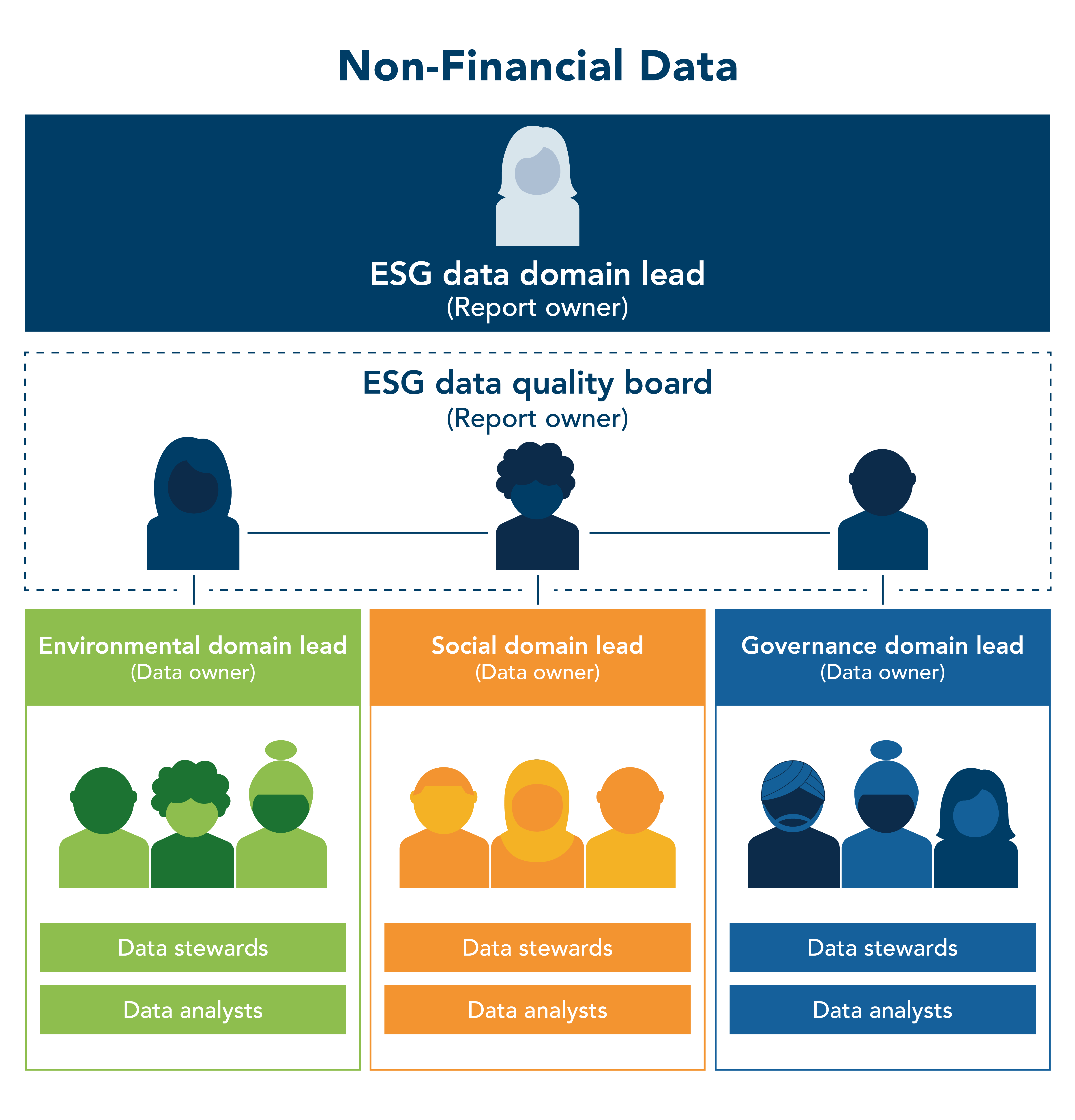
Source: Embedding Project
Finally, an important – and often overlooked – part of establishing good data governance is getting back to basics and ensuring everyone is on the same page. This includes learning the competencies of individuals and teams, securing buy-in for new data governance processes, and centralising and making accessible resources that help build consistency in knowledge, including guides, playbooks, and webinars.
It also means focusing on near-term improvements – don’t be overwhelmed by the desired or required end state. Consider narrowing and focusing your scope of work and scaling back to make consistent progress on improving your data collection and management processes.
3) Improve your data stewardship
Data stewardship is a collection of data management practices designed to help ensure that data is accurate, consistent, up-to-date, and accessed and used appropriately across the organisation. Think of data stewardship as “data governance in action.” Common, well-articulated data management activities include standardised methods for data collection (including data minimisation and ensuring data is fit-for-purpose), verification, encryption, storage, organisation, and analysis.
Companies should be working towards establishing a comparable level of internal controls for non-financial data as they have for financial data. To improve the quality of your non-financial data, it is important to understand the factors that influences its reliability.
Among other factors, reliable data…
originates from credible, verified sources that are traceable;
is accurate and consistent across systems, time periods, and sources;
is sufficiently complete and comprehensive, both in terms of scope and sample size;
is collected through rigorous and consistent methods and measurement processes that account for potential sampling biases;
is unique and relevant (i.e. is fit for purpose);
is validated and protected against tampering;
is up-to-date and relevant for present-day decision-making;
employs standardised naming conventions, definitions, units of measurement, and formatting;
has consistent storage policies;
has consistent reporting formats;
and features transparent error management techniques and margins.
Ensuring data reliability is an ongoing commitment, and one that provides a strong foundation for present and future decision-making and analysis. Start by documenting the current processes used to gather data, assess the variation in these processes, and take steps towards greater alignment and consistency.
Use validated and calibrated tools and methods that have been tested for accurate, repeatable, and representative data for both qualitative and quantitative data validity.
When reporting, you should describe the methodologies, tools, and data platforms used to obtain key data; the assumptions, tools and data platforms used to calculate or estimate non-financial indicators and metrics; and any limitations, including a lack of data or the use of proxy data and industry averages. When data is acquired indirectly, such as from suppliers, customers, industry averages, or through proxies, be sure to consider and verify the methodology for collecting data and the information sources used.
4) Prepare for assurance - verify the quality of your data
There are growing expectations for the assurance of non-financial information, driven both by regulatory pressures and from customers. Increasingly, procurement processes reward (and in some cases, require) third party verification of sustainability data (such as greenhouse gas (GHG) emissions).
Now is the time to prepare. It is essential to test your data. Consider how you can leverage the skills of your internal finance team to help your organization to build the right skill sets and support strengthening the quality of your non-financial (ESG) data.
This includes assessing and working to improve its accuracy, completeness, consistency, and other key factors that support high-quality data. It also includes being transparent about improvements made to data quality since previous disclosures; clarifying plans to improve data quality in the future; and being transparent about barriers to such improvements and the approaches under consideration for overcoming them.
Both internal and third-party data auditing are helpful methods for assessing the quality and reliability of your data. Audits examine the sources of data, the methods of collection, and how the data has been used and changed over time. They are a helpful tool for uncovering gaps and weaknesses in the data pipeline; ensuring consistency across business units; improving trust from investors and other key stakeholders; reducing risk; improving internal reporting and management systems; improving board and CEO engagement; and increasing the value of your non-financial disclosures and their potential for supporting your sustainability objectives.
5) Leverage technology for quality control and continuous monitoring
Explore opportunities to integrate new technology and automation to support better data quality.
It is also worth evaluating the potential benefits of centralised ESG data dashboards and management systems (including modern SaaS-based ESG platforms) for real-time collaboration, version control, and streamlined sustainability disclosure. These tools can be both internal or externally facing, and can help you to consolidate, track, analyse, and display key performance indicators and data points in an accessible format.
For certain applications, automation can improve the quality of data by reducing the risk of human error and bias and by enhancing the scalability of control methods. Real-time monitoring systems can also help locate and flag anomalies and inconsistencies in data. Feedback from such systems – as well as standardised processes for corrective action – should be integrated into your data governance policies.
While AI and machine learning have the potential to further enhance real-time monitoring and the detection of trends, anomalies, and inconsistencies, it is vitally important to observe and scrutinise results. Be sure to pilot-test nascent tools and technologies before integrating them into your data governance processes, and commit to appropriate oversight and review thereafter.
6) Establish feedback mechanisms and engage in routine reviews
Establishing robust feedback mechanisms is essential for improving and sustaining data quality. This includes periodic reviews with subject matter experts to review key sustainability issues, the types of data being collected, and the methods for collection. It also includes updating internal controls and documentation, establishing regular cross-functional check-ins, and developing escalation processes for emergent data quality issues, among other actions.
Documentation is important and often overlooked. Be sure to document data collection methods, definitions, metrics, disclosure policies, and more. This will help to ensure that everyone has a common understanding of the data and how it needs to be measured and reported.
Resources to help you get started
As a baseline, every company that seeks to improve the quality of their non-financial data will require good data governance and accountability, clear processes, and appropriate software systems to support the processes.
In addition to some of the links above, additional resources include this step-by-step guidance from IBM on setting up a data governance program and Sustainability Directory’s guidance for verifying ESG data.
To learn more about data oversight and why it matters to business, check out our Issue Snapshots and keep an eye out for our upcoming Getting Started Guide on Data Oversight.